Private credit and syndicated lending have grown into one of the largest corners of the capital markets, and the operations behind them have not kept pace. A loan that trades in minutes can take weeks to settle, and a facility worth a billion dollars is often administered through a shared inbox, a folder of PDFs and a spreadsheet that one person on the team understands. The industry has started to say this out loud, and the conversation has moved quickly from digitizing these workflows to handing parts of them to AI agents.
That ambition is reasonable, although it skips a step. Before an agent can reconcile a position, test a covenant or process an amendment, something has to turn the documents that govern the loan into data the agent can rely on. In lending, that is where most of the difficulty lives.
The loan is the paper
A bond is largely described by a handful of standardized fields, whereas a loan is described by its documents. The credit agreement runs to hundreds of pages, with pricing grids that step with leverage, baskets and carve-outs written in defined terms that are themselves defined elsewhere in the agreement, and covenant calculations that depend on adjustments negotiated deal by deal. Every amendment changes some of that, usually by reference to the original text, so that the terms in force on any given day are spread across several documents.
The life of the loan then arrives as a steady stream of agent notices covering rate sets, drawdowns, repayments, rollovers and PIK elections, each one formatted the way that particular agent has always formatted it. Borrowers send quarterly financials and compliance certificates as PDFs or scans, with tables laid out however their accounting system exported them. Operations teams read all of this and key it into servicing and portfolio systems by hand, which is why headcount in loan operations has tended to scale with volume.
The bespoke nature of these instruments is a feature of the asset class, since it is what lets lenders and borrowers structure around a specific situation. Standardization efforts such as common identifiers and shared portals help with distribution and tracking, but they do not change the fact that the substance of each deal is written in prose and tables that were never designed to be machine-readable.
What this looks like in practice
A few everyday tasks show how much of the work is reading a document and retyping what it says.
- Setting up a new facility. When a deal closes, someone reads the credit agreement and builds the loan in the servicing system by hand, including each tranche, the pricing grid, the fee schedule, the amortization table and the payment dates.
- Processing a rate set notice. The agent emails a PDF stating the new benchmark rate, the margin and the dates of the next interest period. An analyst keys those values into the system for every position the firm holds, and a single mistyped digit produces the wrong accrual until someone catches it.
- Booking a drawdown or repayment. A borrower draws on its revolver or prepays part of a term loan, and the agent sends a notice with each lender's share. Operations updates the position, works out the expected cash and reconciles it against the wire when it arrives.
- Settling a secondary trade. Closing a trade means matching the trade confirmation, the assignment agreement, the agent's consent and a funding memo that calculates the purchase price and any delayed compensation, and then checking all of it against the firm's own record of the trade.
- Working through an amendment. A repricing or maturity extension arrives as a new legal document and a consent request with a deadline. Teams track responses across email threads, and once it passes they have to find and update the margin, floor or maturity in every system that holds the old terms.
- Testing covenants each quarter. The borrower sends financial statements and a compliance certificate. An analyst spreads the numbers, rebuilds EBITDA according to the definition in that particular agreement, including whatever add-backs were negotiated, and compares the resulting leverage ratio with the threshold in force for that period.
None of these steps is difficult in isolation. Multiplied across hundreds of facilities and dozens of agents, each with its own templates, they add up to teams that spend most of their day moving numbers from documents into systems.
Why general-purpose models struggle here
Large language models are good at summarizing a credit agreement and much less dependable at the tasks loan operations require. A pricing grid is a table whose meaning depends on its structure, and a model that misaligns one row will report the wrong margin with complete confidence. A notice that arrives as a low-quality scan will have a digit misread. A leverage covenant references a definition of EBITDA forty pages away, and the amendment that changed it sits in a different file altogether.
There is also the question of consistency. An operations process needs the same document to produce the same output every time, with each figure traceable to the place it came from, because the output feeds payment calculations, compliance tests and investor reporting. A system that is right most of the time and cannot show its work simply moves the manual effort from data entry to review.
Agents raise the stakes further. A person who sees an odd number in a notice will stop and ask about it, while an agent built to resolve a break or update a position will act on what it was given. The quality of the data layer therefore sets the ceiling on how much of the workflow can safely be automated.
What ground truth requires
For documents to serve as a foundation for automation in lending, a few properties matter more than raw model capability:
- Structural fidelity. Tables, grids and schedules have to come out with their rows, columns and hierarchy intact, including when they span pages or arrive as scans.
- Traceability. Every extracted value should point back to its exact location in the source document, so that a reviewer or an auditor can confirm it in seconds.
- Determinism. The same document should yield the same result on every run, so that downstream systems and controls can be built around it.
- Schemas that match the workflow. Output should arrive in the fields a servicing platform, covenant monitor or reconciliation engine already expects, and those schemas should be able to evolve as deal structures do.
- Deployment inside the perimeter. Loan documents are confidential and often subject to regulatory constraints, which means extraction frequently has to run within the institution's own environment.
Where Pulse fits
Pulse builds document intelligence for exactly this class of material. Its proprietary vision-language models are trained on the layouts that financial documents actually use, and they reconstruct tables and multi-page structures before any language model is asked to interpret them. Extracted values carry references to their position on the source page, and results can be returned against a schema defined for the workflow in question, whether that is a set of covenant terms from a credit agreement, the events in an agent notice or the line items in a borrower's financial package. Pulse runs as a hosted service or inside a customer's own cloud environment, which is how banks, private equity firms and other regulated institutions use it today.
In practice this lets a lending platform or an operations team treat documents as an input rather than a bottleneck. Notices can be turned into structured events as they arrive. Amendments can be compared against the terms they modify. Borrower reporting can be spread and checked against covenant definitions without someone retyping a balance sheet. Human expertise remains essential, and it is spent on judgment and exceptions.
A worked example
To make this concrete, Pulse was run on a document that loan operations teams meet in distressed situations: the 13-week budget attached to a debtor-in-possession financing order, taken from a public bankruptcy court filing. The page holds roughly eighty rows and fifteen columns in very small print and tracks the DIP revolver and term loan week by week. Its embedded text layer is unusable, since copying the numbers out of the PDF returns unreadable symbols, so the figures can only be recovered by reading the page visually.
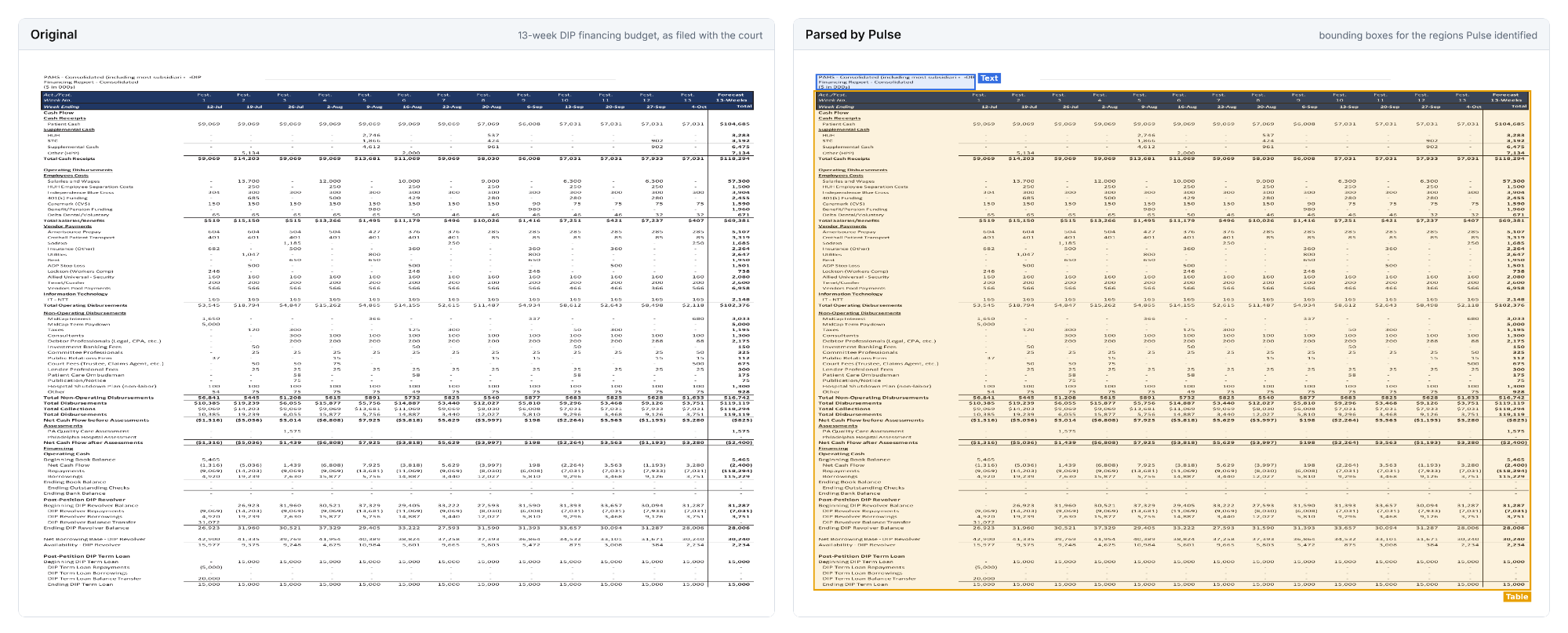
Pulse returned the full table with its row labels, thirteen weekly columns and totals in place, and the subtotals for salaries and benefits and for non-operating disbursements tie to their line items in every week. Output of this kind can be loaded straight into a variance report or a borrowing base check, which is work a lender's operations team would otherwise redo by hand each week of the case.
The order of operations
The firms that will get the most from agents in private credit are likely to be the ones that treat document accuracy as infrastructure and solve it first. Workflow software, shared data standards and AI agents each depend on a reliable answer to a basic question, which is what the documents say. Once that answer is structured, traceable and repeatable, much of what makes loan operations slow becomes tractable, and the bespoke character of the asset class no longer has to come at the cost of scale.