Somewhere in every utility’s archive sits the exact equipment rating, relay setting, or interconnection term an engineer needs today, locked inside a PDF, a scanned drawing, or a spreadsheet built for a human reader rather than for any system that might later have to read it back. The information already exists, but it cannot move, and the moment a team tries to pull it into a modern pipeline with off-the-shelf tooling the accuracy quietly falls apart, usually before anyone notices, once the output is already sitting in a system of record. It is the pattern we hear in nearly every conversation with utility teams, where the documents that carry the most operational weight are the ones that resist every general-purpose tool anyone points at them.
What makes a utility document hard
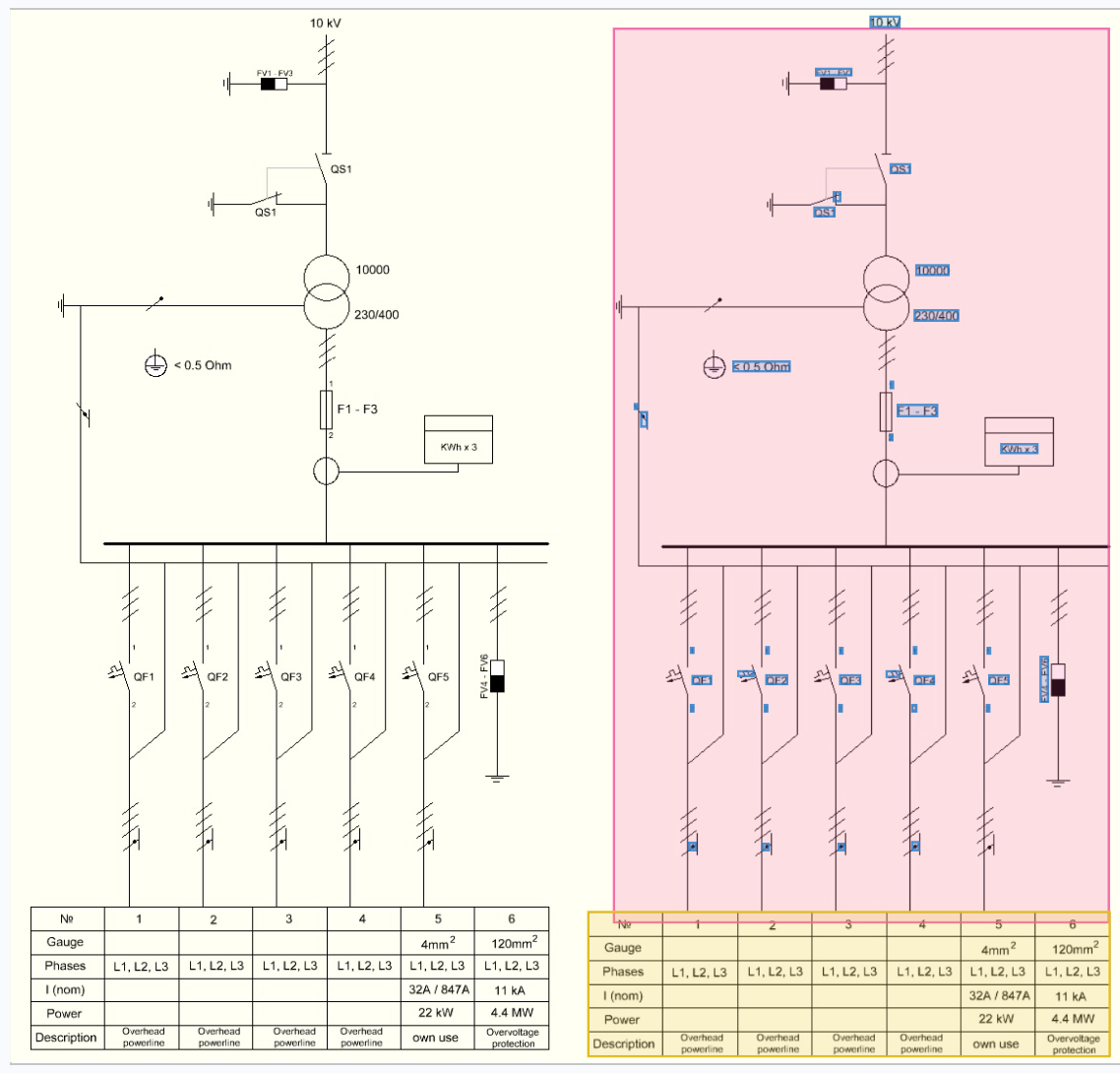
The formats that matter in a utility are dense and unforgiving, since single-line and three-line diagrams pack ratings, relay settings, and equipment identifiers into schematics where the position of a label is half its meaning, protection drawings arrive as scanned vectors marked up by hand years apart, inspection reports mix free text with structured condition codes, and interconnection agreements run for hundreds of pages of exhibits and tables. What ties them together is that each one assumes the reader already knows the conventions and understands what a blank cell or an unlabeled node implies, so the structure never appears on the page but lives instead in the institutional knowledge of the people who have always read these files by hand.
That is why standing up a single substation record still cannot be handed to software, because an engineer has to read ratings off a decades-old diagram, cross-check them against the nameplate schedule, confirm protection settings in a coordination study, and reconcile all of it against the asset system, with the answer spread across differently formatted documents produced at different times by different vendors and stitched together entirely in their head. The same reconciliation then gets redone by hand every time a drawing is revised, an asset is replaced, or a regulator asks a question.

Why the problem is only getting harder
The pressure on that archive is rising rather than easing, because interconnection queues have outgrown the teams that process them, grid modernization and electrification are generating drawings, permits, and inspection records faster than anyone can key them into structured systems, and the workforce that carried the institutional knowledge is retiring and taking a decade of unwritten conventions with it. Each of these trends turns the same underlying problem, that the data is trapped in documents built for humans, into a larger and more urgent one.
Where standard extraction falls down
General-purpose extraction was built for clean, linear, text-first documents, so it breaks on utility records in three familiar ways, starting with chunking, which splits a document into fixed windows and severs a table from its header or a rating from the node it describes, continuing with flattening, where optical character recognition reduces a schematic to a stream of characters and loses the spatial relationships that separate a bus from a breaker, and ending with schema drift, where a pipeline tuned to one operator mislabels fields the moment it meets a document from another vendor, region, or vintage, which across an archive assembled over decades is the rule rather than the exception. A ninety-five percent accuracy rate reads well in a demo and fails in production, because here the five percent is a misread relay setting or a transposed rating that passes silently into a system of record and surfaces only later, as a load study that misjudges a transformer, a relay that fails to trip during a fault, or a filing out of step with what a regulator was told, which is the point at which it is most expensive to fix.
What accurate extraction requires
Doing this correctly means reading a document the way the engineer who drew it would, which takes models that are aware of layout so a rating stays attached to its node and a table to its header, schema mapping that normalizes identifiers and field names across operators, regions, and formats, and fidelity that recovers a value inside a schematic as cleanly as one in a paragraph, whether the source is a crisp digital export or a faded scan of a forty-year-old drawing. Above all it takes field-level accuracy with traceability back to the source page, table, or coordinate, because in a regulated environment every extracted value has to be defensible to an engineer, an auditor, or a regulator before it is allowed anywhere near a system where decisions get made.
What this means
The gap between having a document and being able to act on what is inside it is where utilities lose the most time and money, and it is exactly the gap generic extraction cannot close, since the hardest utility documents are also the most valuable. Closing it is not about asking engineers to work faster or forcing brittle tooling onto documents it was never built for, but about reading each one the way its author intended, preserving the layout that carries the meaning, and grounding every extracted value back to where it came from, which is what turns the drawings, reports, and filings that used to bottleneck engineering and compliance into structured inputs that flow straight into the systems where the work actually happens.