Most document AI conversations focus on text recognition accuracy. Did the system get the words right? That matters, but it is table stakes. The question that actually determines whether a document AI system survives in production is different: can you prove where every extracted value came from?
This is the source linking problem. It shows up in every regulated industry we work in, and it is the requirement that separates systems built for demos from systems built for production.
The problem with text-only extraction
Consider a 300-page regulatory filing processed through a standard extraction pipeline. The system returns structured JSON with all the right fields populated. Numbers look correct. Tables are present. On the surface, everything works.
Now a compliance analyst needs to verify a single number. They need to confirm that the figure "$14.2M" in the structured output corresponds to a specific cell in a specific table on a specific page of the source document. With text-only extraction, this is not possible. The system knows the text exists somewhere in the document, but it cannot point to where. The spatial relationship between the extracted value and its position on the page has been discarded.
This is not an edge case. It is the default behavior of most extraction systems. They treat documents as streams of text and throw away the geometry that gives that text meaning.
What word-level bounding boxes actually enable
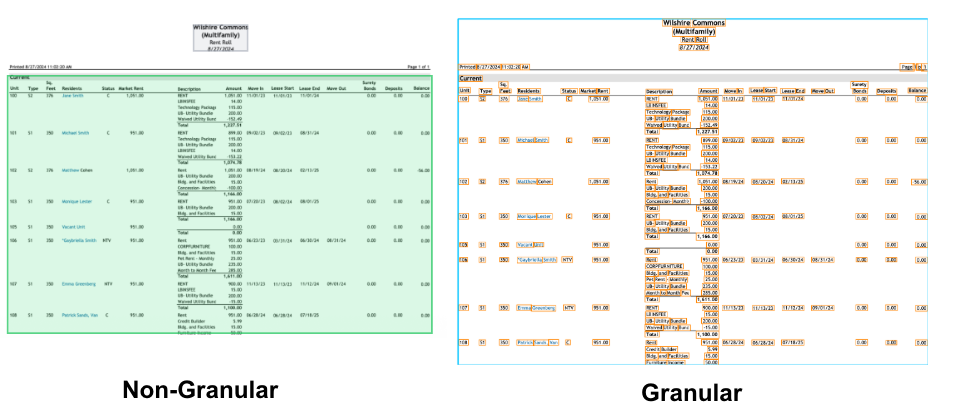
A word-level bounding box is a set of coordinates that defines the exact position of a word on the page. At Pulse, we return these as normalized 8-point coordinates for every extracted element, from individual words to full document segments. The coordinates are resolution-independent, which means they work regardless of how the source document was scanned or rendered.
This sounds simple, but the downstream consequences are significant.
Table reconstruction without gridlines. Most financial documents contain tables with no visible borders. The only way to reconstruct column and row structure is by analyzing the spatial relationships between words. Words that share similar x-coordinates across multiple rows likely belong to the same column. Large horizontal gaps between word clusters indicate column boundaries. Vertical gaps between rows establish row breaks. Without word-level positions, table detection is guesswork. With them, you can reconstruct grid structure from spatial signal alone.
This is particularly important for documents where the same layout template produces wildly different table shapes depending on the data. A portfolio report with three holdings and a portfolio report with three hundred holdings use the same template, but the resulting tables have completely different geometry. Word positions are the invariant that makes both parseable.
Reading order in complex layouts. Multi-column documents are common in financial services: research reports, prospectuses, regulatory filings. A naive top-to-bottom extraction reads across columns instead of down them, producing text that interleaves unrelated content. Word-level bounding boxes let you detect column breaks by identifying large horizontal gaps in word positions, then sort words within each column by their vertical coordinates. The result is text that follows the reading order the author intended.
This extends beyond columns. Footnotes, sidebars, headers, page numbers, and callout boxes all occupy distinct spatial regions. Without word positions, these elements get concatenated into the main text stream. With word positions, they can be identified, separated, and linked to the content they reference.
Audit trails and source linking. Every extracted value in a Pulse output carries its complete provenance: source document, page number, and the bounding box coordinates that locate it on the page. This creates a chain of custody from raw document to structured output.
In practice, this means a compliance team can click on any value in the structured output and see exactly where it appears in the source document. Not "somewhere on page 12," but the precise region, highlighted at the word level. This is not a convenience feature. For financial data providers, it is the mechanism that allows end clients to validate data against source documents. Without it, the entire trust model breaks down.
Downstream pipeline reliability. Bounding boxes are not just for display or human review. They are the connective tissue between document parsing and everything that comes after it. Named entity recognition, sentiment analysis, entity resolution, and LLM-based extraction all perform better when they receive spatially contextualized input rather than a flat text stream.
A number extracted from a table cell has different meaning than the same number extracted from a footnote or a page header. Bounding boxes encode this context. When your parsing layer discards spatial information, every downstream process inherits that blind spot. They receive text without knowing where it came from or what surrounded it on the page.
Why this matters for enterprise evaluations
The pattern we observe across enterprise bake-offs is consistent. Teams begin by testing text accuracy, running documents through multiple vendors and comparing character error rates and word error rates. These metrics matter, but they rarely differentiate vendors at the enterprise level. Most serious extraction systems achieve comparable OCR accuracy on clean documents.
The differentiation happens on spatial fidelity. Can the system return word-level coordinates that are precise enough to support source linking? Can it reconstruct tables without explicit gridlines? Does reading order hold up on multi-column layouts? Can every extracted value be traced back to its exact position in the source document?
These are the requirements that separate the final two vendors in an evaluation. They are also the requirements that are hardest to retrofit. A system that was not built around bounding boxes from the start cannot easily add them later, because the entire extraction architecture needs to be designed around preserving and propagating spatial information through every stage of the pipeline.
The coordinate system matters
Not all bounding box implementations are equal. Some systems return page-level coordinates that break when documents are re-rendered at different resolutions. Others return bounding boxes only at the paragraph or region level, which is too coarse for word-level source linking.
Pulse returns normalized coordinates in a 0-to-1 range using an 8-point format that defines the four corners of each bounding box. Normalizing to the 0-to-1 range makes the coordinates resolution-independent. Converting to pixel coordinates for any given rendering is a single multiplication by page width and height. The 8-point format accommodates rotated text and skewed scans, which a simple 4-point axis-aligned rectangle cannot.
This matters because enterprise documents are messy. Scanned PDFs arrive at inconsistent resolutions. Pages are rotated. Text is skewed from imperfect scanning. A coordinate system that assumes clean, axis-aligned documents will produce inaccurate positions on real-world inputs.
Building from the foundation up
Word-level bounding boxes are not a feature you add to a document AI system. They are a design decision that shapes everything else. Table detection, reading order, source linking, confidence scoring, downstream pipeline integration: all of these depend on having precise spatial information at the most granular level.
We built Pulse around this principle from the start. Every stage of the pipeline preserves and propagates bounding box coordinates, from initial OCR through layout analysis, table reconstruction, and structured output generation. The result is an extraction system where every value, in every output format, can be traced back to its exact position in the source document.
For enterprise teams evaluating document AI, this is the capability worth testing first. Everything else depends on it.
--
Pulse returns normalized bounding box coordinates for every extracted element. If source linking and spatial traceability matter for your pipeline, talk to us.