The most regulated companies in the world already run their data on Snowflake. The problem is that some of their most valuable information never makes it there. It sits in PDFs, scans, drawings, and maps that no warehouse can read on its own.
Pulse closes that gap. It turns complex documents into clean, structured data and delivers it straight into Snowflake, where it can sit next to everything else a business already trusts.
Regulated industries trust Snowflake with their data
Energy companies, banks, insurers, and healthcare organizations live under heavy scrutiny. Regulators, auditors, and boards all expect to know where data lives, who touched it, and why a number is what it is.
That is why so many of them have standardized on Snowflake. It gives them one governed place for their data, with role-based access, auditing, and security controls built in. Finance, operations, and analytics teams can work from the same source of truth instead of a dozen disconnected copies.
But most of what they know is locked in documents
Warehouses are built for rows and columns. Real businesses run on documents: contracts, invoices, filings, reports, scanned forms, and technical drawings. Most enterprise information arrives in this unstructured form.
Those files carry the details that matter most. They hold the terms of a lease, the depth of a well, the pressure rating on a valve, or the exceptions buried in a policy. Yet they rarely make it into the governed data platform, so they cannot be searched, joined, or analyzed alongside everything else.
The usual workarounds do not hold up. Manual data entry is slow and error-prone. Basic OCR reads text but loses the structure: tables break apart, handwriting gets skipped, and nobody can tell which values to trust.
An example from energy: decades of data in files
Take a large oil and gas operator. Over decades it has collected huge volumes of technical documents:
- Well logs that record what was found at every depth of a well
- Engineering schematics for equipment, piping, and facilities
- Land and subsurface maps showing leases, boundaries, and geology
- Scanned field records from acquisitions, many of them handwritten or decades old
Today, most of this lives in one of two places. Some of it sits in shared drives and document management systems, where only someone who knows exactly which file to open can use it. The rest feeds a single-purpose pipeline, built years ago for one team and one application, that nobody else can tap into.
Either way, the knowledge is trapped. A geoscientist cannot easily compare logs across thousands of wells. An engineer cannot search every schematic for a specific part number. A land team cannot connect lease terms to production data sitting in Snowflake. The answers exist, but they are scattered across files no system can read.
Bridging the gap
The value of document data multiplies when it joins the rest of the data ecosystem. A lease term means more next to production volumes. A valve rating means more next to maintenance history. A handwritten field note means more when it can be searched across every asset the company owns.
To get there, companies need three things:
- Accurate extraction that understands tables, layouts, handwriting, and drawings, not just loose text
- Trust signals that show which values are reliable and which need a human to check
- A governed destination where the results land with the same security, access controls, and audit trail as every other dataset
Pulse delivers the first two. Snowflake delivers the third.
What Pulse and Snowflake unlock together
Together, Pulse and Snowflake turn a file archive into a living, governed dataset. Documents go in, structured data comes out, and it lands where the rest of the business already works.
What Snowflake brings
- The full picture. Document data sits next to production, finance, and operational data, so teams can ask questions that span all of it.
- One governed home. The same access controls, auditing, and security apply to extracted data as to every other table.
- Pipelines that run themselves. New documents flow in, get processed, and land in tables without anyone moving files by hand.
- Every downstream tool. Analysts, dashboards, and AI applications use the data the moment it lands.
What Pulse brings
- Accuracy on hard documents. Pulse reads tables, layouts, handwriting, and drawings, not just text. On PulseBench-Tab, an open table-extraction benchmark built with academic contributions from S&P Global, Pulse Ultra 2 scores 93.5%. The best general-purpose AI model scores 84.9% (source).
- Confidence you can act on. Every extracted field comes with a confidence score and a link back to where it appears on the page. Clean documents flow straight through, and only uncertain values go to a person for review.
- Enterprise security. Pulse is SOC 2 Type II and ISO 27001 certified, complies with GDPR, and offers a HIPAA BAA (source). It can also run in a private cloud or on-premises.
- Proven at scale. Pulse has processed over 1 billion pages for teams ranging from startups to Fortune 10 enterprises (source).
How it all connects
The setup is simple. Documents land in Snowflake, Pulse reads them, and the results come back as governed tables.
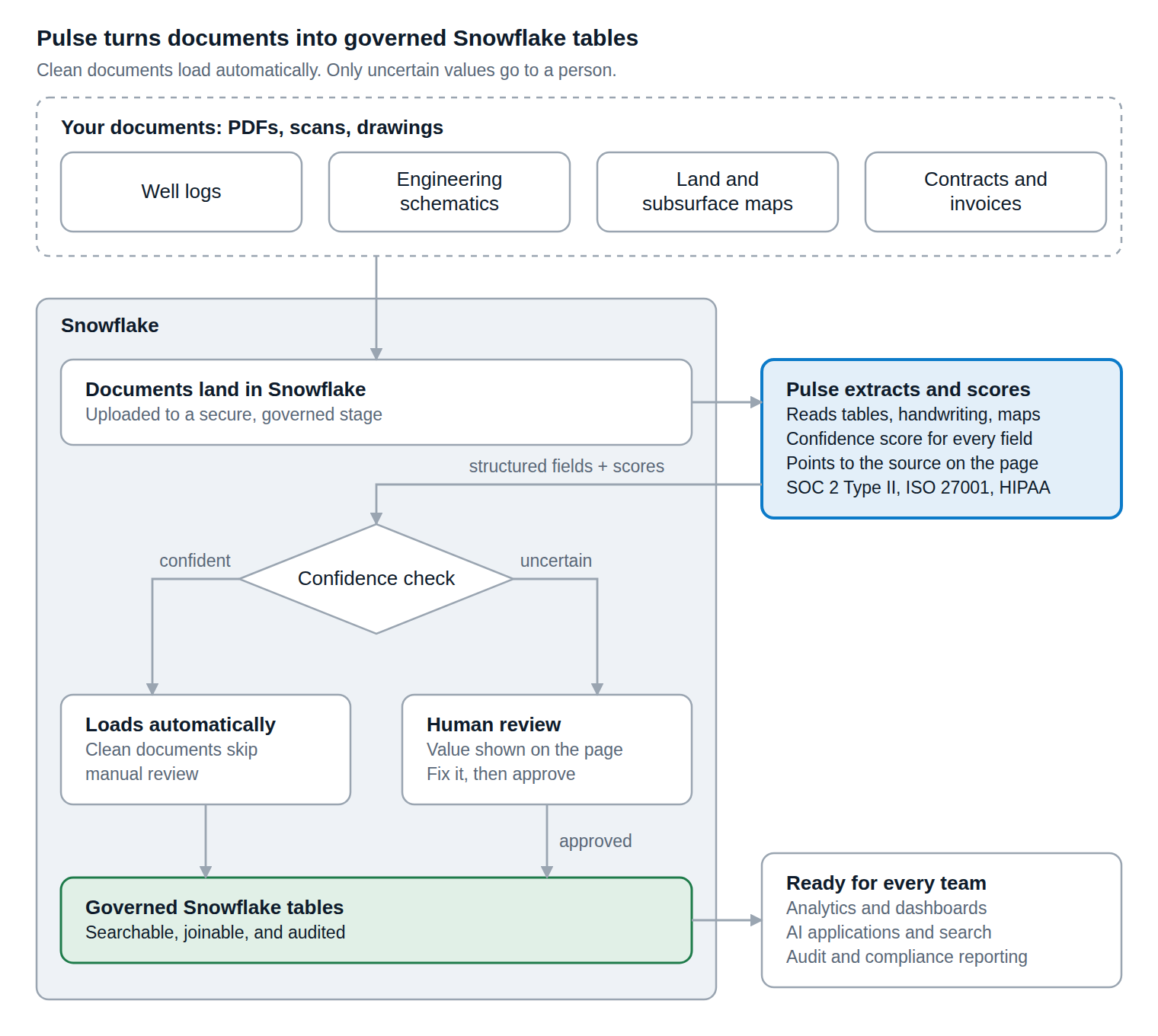
Pulse + Snowflake architecture: documents to governed tables
- Land. Documents are uploaded to a secure stage inside Snowflake.
- Extract. Pulse reads each document and returns structured fields, a confidence score for each one, and its location on the page.
- Check. Fields that clear the confidence bar load automatically. Anything uncertain goes to a reviewer, who sees the value highlighted on the original page.
- Use. Approved data lands in Snowflake tables, ready for analytics, dashboards, and AI applications, with a full audit trail of what was corrected and by whom.
From archive to advantage
Every regulated company already has the data it needs to make better decisions. Much of it is simply sitting in documents nobody can query.
Pulse and Snowflake change that. The well logs, schematics, and maps that once lived in file shares become tables a geoscientist can filter, an engineer can search, and an analyst can join to production data. The documents stay the source of truth, and now the business can actually use them.
Want to see it on your own documents? Talk to the Pulse team.

.svg)

.svg)