Every barrel of crude that leaves a lease tank on a truck starts its financial life as a few pencil marks. Before it is nominated, scheduled, blended, or refined, a driver or gauger climbs the tank, drops a tape, reads the oil level in feet, inches, and fractions of an inch, pulls a thief sample, checks gravity and temperature, spins a grind-out for sediment and water, and writes all of it onto a carbon-copy form called a run ticket. That ticket is the custody transfer record. It sets the volume the purchaser pays for, the volume the producer reports as sold, and the volume the royalty owners and the state are paid on, and on many leases it is still written by hand.
Field tickets get a lot of attention for the cost side of the business, where a long tail of vendors bill against service work. Run tickets sit on the other side of the ledger, at the point where molecules change hands, and the extraction problem they pose is different in kind. The hard part is not that every vendor uses a different template. It is that the values on the page are measurements, written quickly in the field, in units and shorthand that only make sense if the reader understands how a tank is gauged.
Why Handwritten Run Tickets Are Their Own Problem
A run ticket packs a surprising amount of domain logic into a small form. Gauges are recorded across three narrow columns for feet, inches, and fractions, and drivers routinely run the digits together so that twelve feet three inches reads as a single number, 123. A dash in the inches column means zero. A diagonal stroke through the fraction column can mean nothing was recorded, or it can be the tail of the fraction written in the row above. Basic sediment and water shows up as a percentage on one line and as tenths on the next, sometimes both on the same ticket. Delivery stations are abbreviated to whatever the driver and the dispatcher both understand, and dates drift outside their boxes when the printed label is in the way.
On top of the handwriting sits the paper itself. Run tickets are multi-part carbon forms, and the copy that ends up in an accounting office or a regulatory filing is often the producer copy, faxed or scanned at low resolution until the background turns to static. A human who knows the form can still read it, because the human knows that observed gravity on a crude ticket is a two-digit number, that a five-foot drop in a 500-barrel tank is about 167 barrels, and that a temperature of 9 degrees in June is probably 98. A conventional OCR engine knows none of this, and the result is text that looks like data but is not.
A Real Ticket from the Public Record
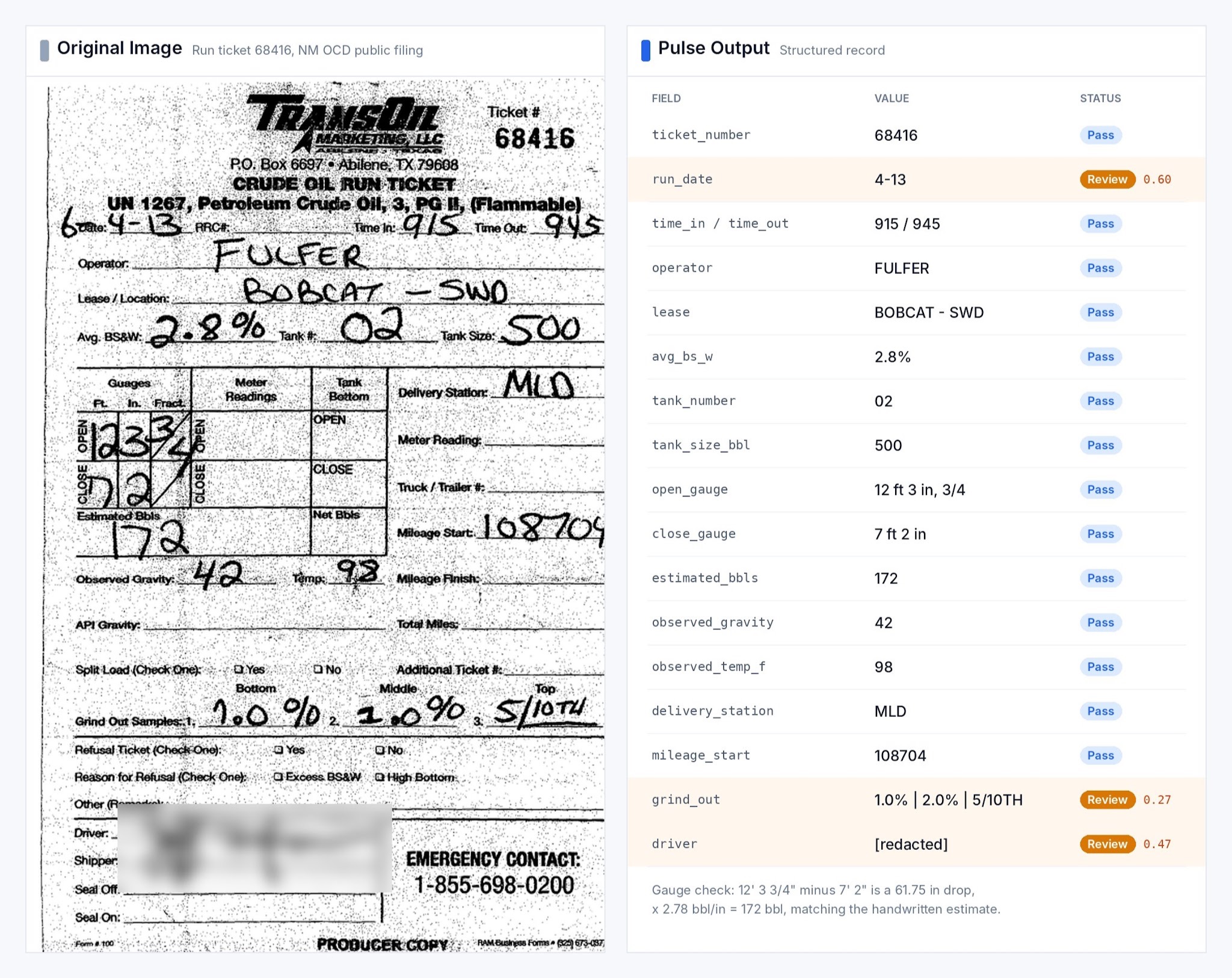
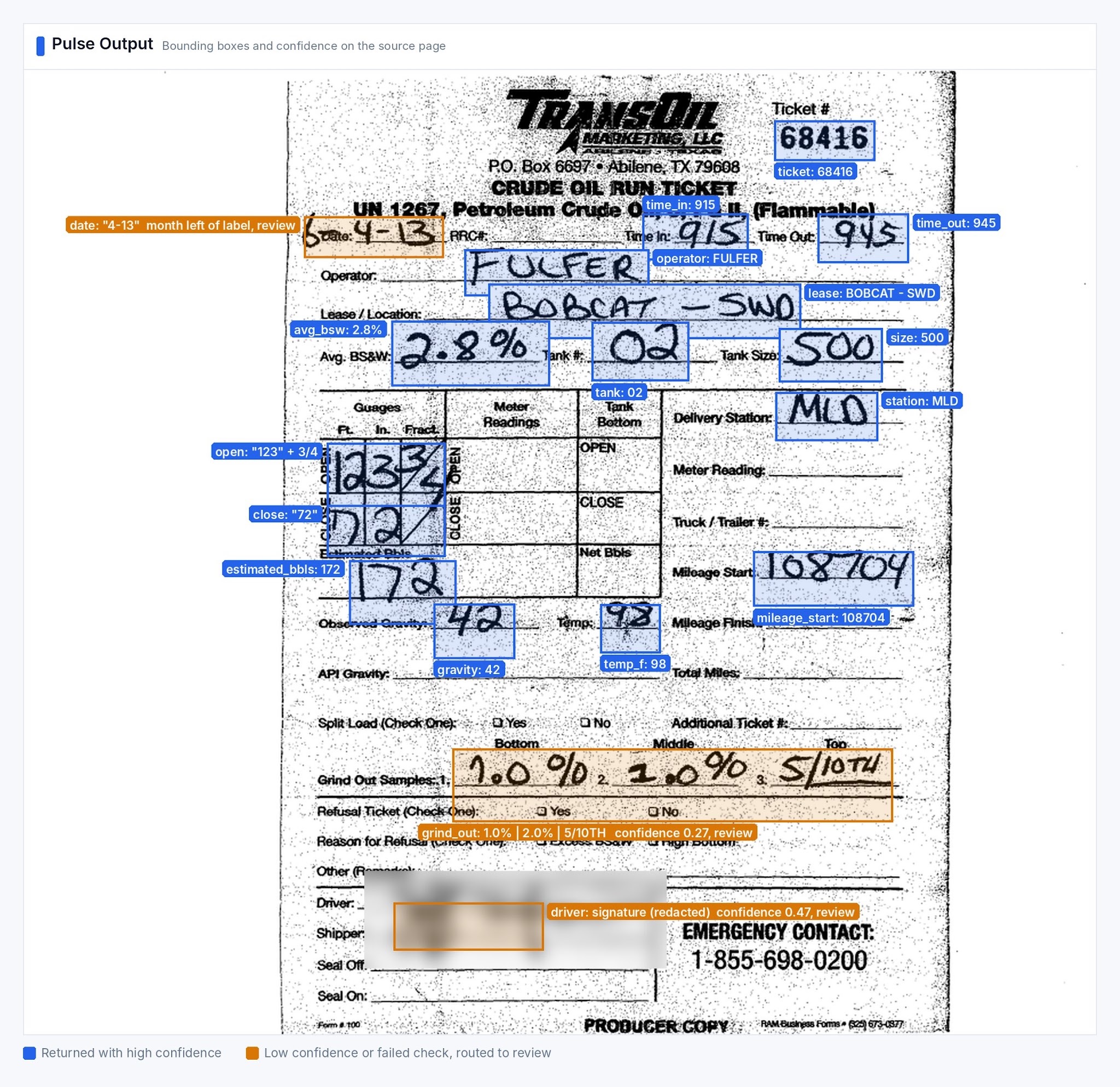
To show what this looks like in practice, the example below comes from a public filing rather than a customer. Operators that sell skim oil from saltwater disposal facilities in New Mexico file the run tickets behind those sales with the Oil Conservation Division, and the state publishes the scans. The ticket shown is run ticket 68416, written in June 2013 for skim oil picked up at the Bobcat SWD in Lea County. It is a fax-degraded producer copy, with heavy speckle across the whole page, gauges written into the feet, inches, and fraction columns without much regard for the column lines, grind-out samples recorded in two different notations, a month written to the left of the printed Date label, and a signature sprawled across both the Driver and Shipper lines.
The scan the state publishes includes its own OCR text layer, and that layer shows how far conventional tools get on documents like this. On the tickets in this filing, the text layer renders the handwritten delivery station as "C M < / > * 6» ^ ^", and most of the handwritten values on the page do not come through as anything usable at all.
What Pulse Returned
Pulse read the ticket directly from the page image, without a template for the TransOil form and without any instructions about run tickets. It returned the ticket number, the time in and out, the operator, the lease, the 2.8 percent average BS&W, the tank number and size, the abbreviated delivery station, the starting mileage, the observed gravity of 42 and temperature of 98, the 3/4 fraction on the opening gauge, and the driver's estimate of 172 barrels, each tied to its location on the page. It also handled the printed portions of the form, including the hazardous materials description and the refusal checkboxes, which a downstream system can use to confirm that the load was not rejected.
Three parts of the ticket did not come back clean, and they are the most instructive part of the example. Pulse returned the date as "4-13" because the driver wrote the 6 for June to the left of the printed label, outside the box where a date belongs. The grind-out row, where the bottom and middle samples are written in near-identical strokes that could be read as a 1 or a 2, came back with a block confidence of 0.27. The signature block came back as a best-guess name with a confidence of 0.47 and was repeated into the Shipper line, because the signature physically spans both. The driver's name and signature are redacted in the figures here. In each case the low confidence lands exactly where a careful human reviewer would also slow down, which is the behavior a production pipeline needs.
From a Good Read to a Record You Can Trust
Reading the page is the first half of the job. The second half is turning that read into a record an accounting or measurement system can rely on, and run tickets are well suited to this because the values on them constrain each other. The feet and inches columns fix how a run-together "123" splits, since no lease tank is 123 feet tall. The opening gauge of 12 feet 3 3/4 inches and the closing gauge of 7 feet 2 inches give a drop of 61.75 inches, and at roughly 2.78 barrels per inch for this 500-barrel tank that works out to 172 barrels, the same number the driver wrote in the estimate box. When the gauges and the estimate agree, the volume fields can flow through without a second look. When they do not, the ticket is flagged before it reaches settlement.
The same approach covers the rest of the form. Observed gravity outside the range crude can physically take, a date with no month, a BS&W reading above the purchaser's rejection threshold, or a ticket number that does not fall in the carrier's sequence are all simple rules once the values are typed and located on the page. Pulse supplies the read, the coordinates, and the confidence for every value, and the checks decide what goes straight to the measurement system and what goes to a person. Because every value carries its bounding box, the reviewer sees the exact pencil mark behind the number rather than hunting through a stack of scans, and an auditor or a counterparty can do the same months later.
The First Number in the Chain
For crude purchasers, gathering operators, and the data teams that support them, the run ticket is the first number in a chain that runs through purchase statements, pipeline nominations, inventory, royalty and severance reporting, and eventually the refinery's crude slate. Everything downstream inherits whatever error was introduced when a handwritten ticket became a row in a database. Getting that step right on the hardest tickets, the faxed, speckled, hand-gauged ones, and knowing precisely which values need a human, is what lets the rest of the chain run on data instead of on re-keying. Pulse is built for exactly this kind of document.