The best insurance claims document extraction software handles the documents claims teams actually receive: faxed loss runs, ACORD forms, handwritten adjuster notes, medical bills and multi-document claim packets, and returns values that can be checked against the page before they reach a claims system. Pulse is built for those documents, returning structured data against a schema with a bounding box and confidence score for every value, and it can run in a carrier's own VPC or on-premises. Hyperscience and Indico Data are established insurance-focused platforms with review workflows, ABBYY and Tungsten Automation serve carriers with mature capture operations, and the cloud OCR services suit teams building their own pipelines.
This guide is published by Pulse, which appears in it. Descriptions of other products are based on their public documentation at the time of writing, and capabilities change, so confirm current details with each vendor.
Why claims documents are hard
Claims intake combines almost every difficult document type in one workflow:
- Loss runs arrive from prior carriers in every layout, often faxed, with fixed-width columns, recoveries printed with trailing minus signs and totals that must reconcile.
- ACORD forms are standardized but filled in by hand or by different systems, with checkboxes that carry meaning.
- Claim packets mix first notice of loss, photos, estimates, police reports and correspondence in one file that has to be split before it can be read.
- Medical bills and explanations of benefits hold dense tables of codes and amounts, and handling them involves health information subject to HIPAA.
Errors are costly in both directions: a misread reserve changes an underwriting decision, and a missed recovery leaves money on the table.
Worked example: a faxed loss run
The specimen below is a synthetic three-year loss run with fictional parties: 34 claims in a fixed-width layout, received by fax, with recoveries printed with trailing minus signs and handwritten broker notes.
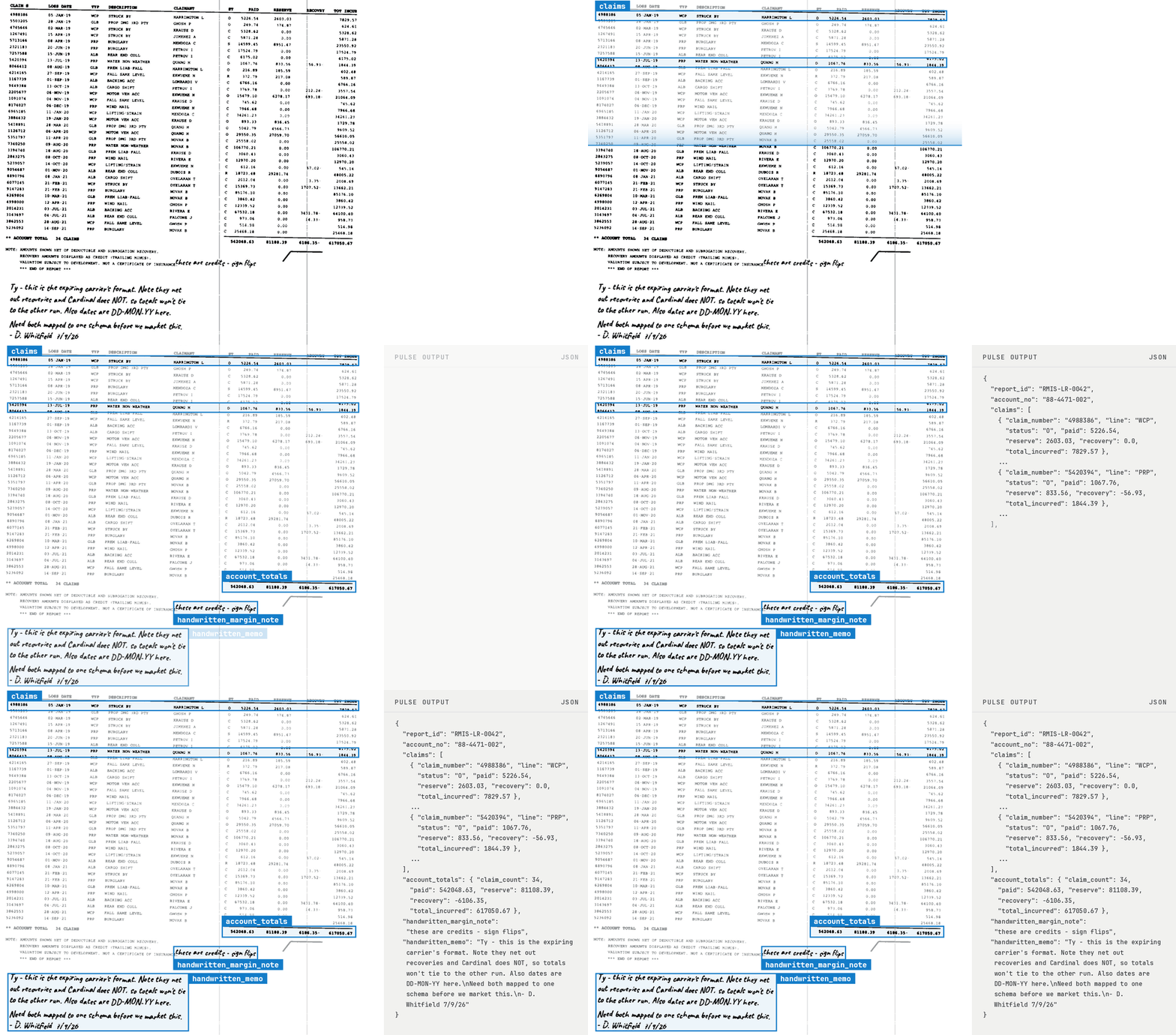
Pulse output on the faxed loss run, with claim rows, account totals and both handwritten notes detected and returned as fields
Given a schema for each claim and for the account totals, Pulse returned the claim rows with line of business, status, paid, reserve, recovery and total incurred, and the account totals of $542,048.63 paid, $81,108.39 reserved and $617,050.67 incurred. It read the trailing-minus recoveries as negative numbers, so total recoveries came back as -6,106.35, and it transcribed the broker's margin note and the handwritten memo below the table. One paid amount was misread on this run, 3,769.78 returned as 1,769.78, which is exactly the kind of error a row-level check catches at volume: on every row, paid plus reserve plus recovery should equal total incurred, and a row that fails goes to review. Any platform under evaluation should be judged on how easily it supports that check, not only on how often it is right.
The best claims document extraction software, compared
1. Pulse
Pulse parses complex claims documents and extracts fields against a user-defined schema, with a citation and confidence score for each value so reviewers can verify it on the page. It splits mixed claim packets into their component documents, handles handwriting, checkboxes and multi-page tables, and processes PDFs, scans, images, spreadsheets and Office files. Carriers can deploy it in their own VPC, on-premises or air-gapped, with zero data retention and a HIPAA Business Associate Agreement on Enterprise plans, and Pulse is SOC 2 Type II and ISO 27001 certified. Best for carriers, TPAs and insurtechs that need accurate extraction from messy claims files and want to build review rules on top of it.
2. Hyperscience
Hyperscience is widely used by insurers for claims and application intake, with strong handwriting recognition, human-in-the-loop review and on-premise or air-gapped deployment. Best for high-volume forms processing with dedicated review teams.
3. Indico Data
Indico Data positions itself as an intake and orchestration platform for insurance operations, covering underwriting submissions and claims first notice of loss, with an integration into Guidewire ClaimCenter. Best for underwriting and claims operations teams that want an insurance-specific workflow product.
4. ABBYY
ABBYY provides mature capture and OCR with template-based extraction, used by insurers for standardized forms. Best for carriers with established capture operations and stable form types.
5. Tungsten Automation (formerly Kofax)
Tungsten Automation combines capture with workflow and robotic process automation, which suits carriers that want document intake and downstream process automation from one vendor. Best for enterprises consolidating capture and process automation.
6. Amazon Textract and Azure Document Intelligence
The hyperscaler services extract text, forms and tables and can be assembled into claims pipelines with other cloud services, with Azure offering a prebuilt model for US health insurance cards. Best for carriers with in-house engineering teams standardized on one cloud.
How to choose
Build the evaluation set from real claims: a handful of loss runs from different carriers, filled ACORD forms with handwriting, two or three full claim packets and a sample of medical bills. Score each platform on whole-document accuracy, on how quickly a reviewer can confirm a value against the source, and on whether totals reconcile. Then apply the constraints that do not bend: where health information may be processed, whether a BAA is available, and whether the platform can run inside the carrier's own environment.
Related reading
- How to Evaluate Enterprise Document AI Alternatives
- What Are the Hidden Costs of Building Document Extraction?
- Pulse vs Hyperscience
- Pulse vs Tungsten Automation (Kofax)
- Pulse vs ABBYY
- Pulse vs Instabase