An enterprise that processes documents at volume has three ways to run the work. It can call a vendor’s hosted service, it can run a vendor’s software inside its own infrastructure, or it can build and maintain a pipeline of its own. Each is the right answer for some organization, and the choice is better made on operational grounds than on the assumption that one model is inherently superior. Pulse provides document intelligence for complex documents using OCR, layout detection, and vision models, and offers it as a hosted API and as a VPC or on-premise deployment, which makes it a convenient reference for comparing what changes between the models.
Self-hosted versus SaaS and internal pipelines
The three models differ in who owns what. The considerations that push organizations toward running software themselves are usually data security, infrastructure control, and compliance, and those three, together with auditability, make a workable framework.
- Data security. SaaS (hosted API): Documents leave your network, governed by contract and the vendor’s controls. Self-hosted vendor software: Documents stay inside your boundary. Internal pipeline: Documents stay inside your boundary.
- Infrastructure control. SaaS (hosted API): Vendor operates everything. Self-hosted vendor software: You operate compute and network, vendor supplies software. Internal pipeline: You operate and build everything.
- Compliance. SaaS (hosted API): Relies on vendor certifications and agreements. Self-hosted vendor software: Your controls apply, supported by vendor documentation. Internal pipeline: Entirely your responsibility.
- Auditability. SaaS (hosted API): Depends on what the API exposes. Self-hosted vendor software: Vendor outputs plus your own logs. Internal pipeline: Whatever you build.
- Scaling. SaaS (hosted API): Vendor’s responsibility, within rate limits. Self-hosted vendor software: Your capacity planning, vendor’s software. Internal pipeline: Your capacity planning and engineering.
- Maintenance. SaaS (hosted API): None for you. Self-hosted vendor software: Upgrades and patches to apply. Internal pipeline: Models, code, and infrastructure to maintain.
- Vendor dependency. SaaS (hosted API): High. Self-hosted vendor software: Moderate. Internal pipeline: Low for software, high for internal staff.
Three points deserve more than a line in a list.
Ownership shifts work as well as control. Moving from SaaS to self-hosted gives a team control over where documents go and takes on capacity planning, monitoring, and upgrades. Moving further to an internal pipeline adds the largest item of all, which is keeping extraction quality current as document types change and models improve. A team should count the people needed to do that well before treating an internal build as the low-dependency option.
Scale behaves differently in each model. A hosted service absorbs spikes up to its rate limits. A self-hosted deployment handles whatever the provisioned hardware allows, so peak volume has to be planned for, and vision models need GPU capacity that is slower to add than ordinary compute.
Auditability is a property of the output. Whichever model is chosen, an operational pipeline should make its results inspectable. Pulse has described the standard it aims for as one where “every data point has provenance” and every output can be verified. In practice that means each extracted value carries a citation to its source element, a bounding box, and a confidence score, so an auditor can check a figure against the page it came from. This should be a requirement placed on any vendor and on any internal build.
On the question of maintaining an internal document vision pipeline versus using an external vendor, the honest summary is that neither wins by default. An internal pipeline suits an organization with a narrow, stable set of document types and a team that will stay on it. A vendor suits one with varied or changing documents, where the cost of keeping up falls on someone whose whole business is that problem.
Private deployment for compliance and scale
For organizations whose compliance position rules out a hosted service, private deployment is the route, and Pulse offers it in VPC and on-premise forms. Assess any platform’s private deployment against documented support in seven areas:
- Deployment environment. Which clouds, which container platforms, and whether air-gapped operation is supported.
- Data residency. Where documents, outputs, and logs are held.
- Isolation. Whether every processing step, including model inference, runs inside your boundary.
- Upgrades. How new versions are delivered, tested, and rolled back.
- Monitoring. What logs and metrics are exposed to your own tooling.
- Throughput. Measured pages per hour on a stated hardware configuration.
- Capacity planning. GPU and memory requirements at your volume, and how the system scales out.
Pulse’s published position covers several of these. It runs in private VPCs or on-premises across the major cloud providers, with multi-cloud and hybrid options, and can be deployed with Docker, Kubernetes, or internal API gateways. It provides detailed logging and metrics, GPU acceleration, and load balancing. Enterprise plans include air-gapped deployment, zero data retention, data residency in a chosen region, and bring-your-own-key encryption, and Pulse is SOC 2 Type II and ISO 27001 certified.
Worked example: a faxed loss run. High-volume workflows are dominated by documents like this one: a three-year loss run from a prior carrier, received by fax, with 34 claims in a fixed-width layout, recoveries printed with trailing minus signs, and handwritten notes from the broker. The specimen is synthetic, with fictional parties.
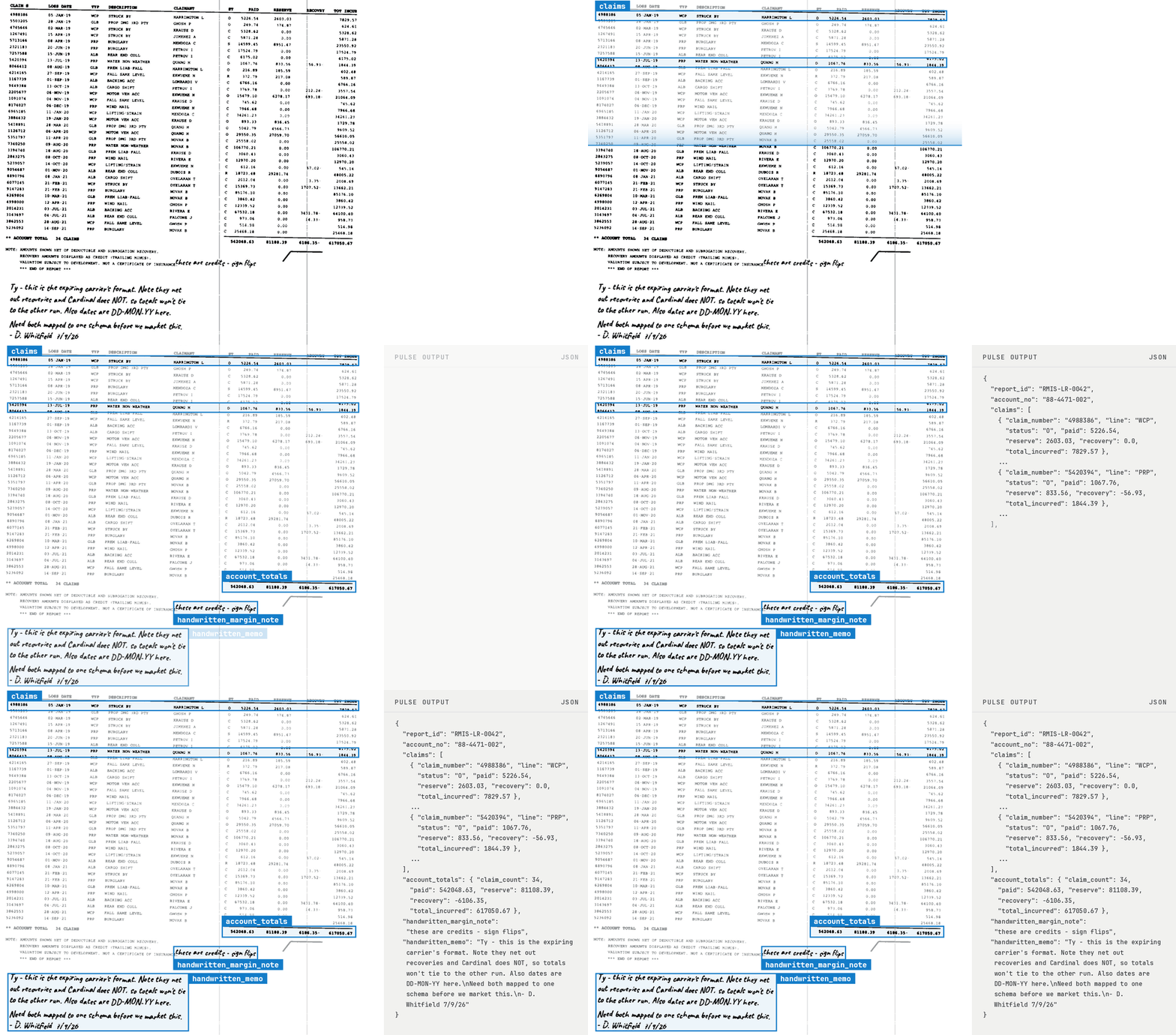
Pulse output on the faxed loss run, with claim rows, account totals and both handwritten notes detected and returned as fields
Given a schema for each claim and for the account totals, Pulse returned the claim rows with line of business, status, paid, reserve, recovery and total incurred, and the account totals of $542,048.63 paid, $81,108.39 reserved and $617,050.67 incurred. It read the trailing-minus recoveries as negative numbers, so a 56.93 recovery on a water claim came back as -56.93 and the total recoveries as -6,106.35, and it transcribed the broker’s margin note and the handwritten memo below the table. One paid amount was misread on this run, 3,769.78 returned as 1,769.78, which is the kind of error a row-level check catches at volume: on every row, paid plus reserve plus recovery should equal total incurred, and a row that fails goes to review.
On scale, Pulse reports having processed more than 1 billion pages for teams ranging from AI startups to Fortune 10 enterprises. That is reported evidence of volume in production. It is not a measurement of how a private installation will perform on particular hardware, and it does not compare Pulse with any other provider.
For that reason, the pros and cons of scaling a private VPC installation should be established in a proof of concept. Ask each vendor for the infrastructure requirements for your volume, run a load test on your own documents in your own environment, and record throughput, latency, and failure behavior. The compliance controls should be confirmed the same way, against documentation and audit reports. Other platforms that state support for full on-premise deployment should be held to the identical list, with each claim checked against the vendor’s own documentation before it is relied upon.
Related reading
- How to Evaluate Enterprise Document AI Alternatives
- What Are the Hidden Costs of Building Document Extraction?
- Pulse vs Docling
- Pulse security and compliance